Axolotl Facts: The Salamander That Never Grows Up
Quick Answer
The axolotl (Ambystoma mexicanum) is a salamander that keeps its feathery gills and lives in water its whole life. It grows about 20 to 30 cm (8 to 12 in) long, is native only to the lake system around Mexico City, and is Critically Endangered in the wild. In human care it lives about 5 to 15 years.
On this page
Key Takeaways
- The axolotl is an amphibian that keeps larval features, such as feathery external gills, as an adult.
- It measures about 20 to 30 cm (8 to 12 in) and weighs about 60 to 110 g.
- It is native only to Lake Xochimilco near Mexico City and is Critically Endangered, though many live in labs and homes.
- It can regenerate many body parts, which is why scientists study it.
- Human-care lifespan is about 5 to 15 years; we found no reliable wild figure.
Axolotl at a glance
Scientific name: Ambystoma mexicanum
| Length | 20–30 cm (8–12 in)(animaldiversity.org) |
|---|---|
| Weight | 60–110 g (2.1–3.9 oz)(animaldiversity.org) |
| Lifespan (human care) | 5–15 years(animaldiversity.org) |
| Diet | Meat-eater that hunts worms, insects, small fish, snails and other small water animals.(animaldiversity.org) |
| Habitat | Rivers & Lakes: Native only to Lake Xochimilco near Mexico City; the species is nearly gone from the wild.(animaldiversity.org) |
| Conservation status | Critically Endangered(animaldiversity.org) |
Sources give different figures for some of these numbers; we show the range they support.
What is an axolotl?
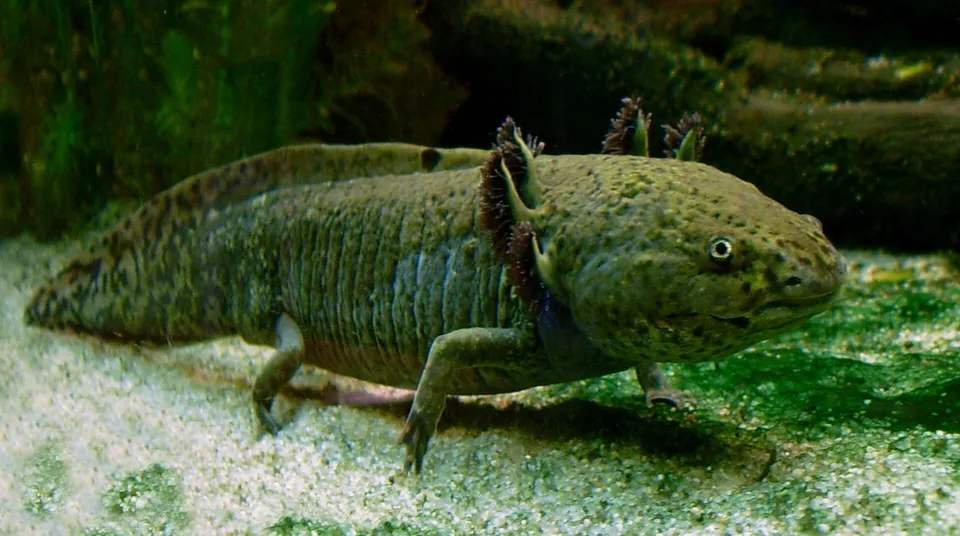
An axolotl is a salamander, which makes it an amphibian, not a fish. Its most striking feature is that it is paedomorphic, or neotenic: adults keep larval traits such as feathery external gills and a finned tail into the reproductive stage of life [1]. Axolotls live their entire lives in the water [2].
So where does "never grows up" come from? In the wild, axolotls rarely if ever metamorphose into a land-living form. Metamorphosis can be induced in a lab with thyroid hormone injections, but most lab animals die shortly after it [1]. A 2022 review also reports that thyroxine-induced metamorphosis reduced regeneration rates by twofold [3]. The animal is not stuck as a baby; it simply reaches adulthood without leaving the water.
Color varies. Lab animals range from a dark, mottled brownish-green, called the wild type, to albino [1].
How big is an axolotl, and what does it look like?
Animal Diversity Web gives an average length of about 23 cm (9 in), says some axolotls exceed 30 cm (12 in), and lists a mass of 60 to 110 g [1]. A 2022 review gives 20 to 35 cm (8 to 14 in) from head to tail [3]. The sources differ slightly at the top end, so we use "about 20 to 30 cm" and treat 30 cm as a common size, not a hard limit.
The easiest feature to spot is the gills: three feathery projections on each side of the head [2]. The body is long and the tail is finned. Males have an enlarged cloaca, the opening used for waste and reproduction, while females have a smaller one and a rounder, plumper body [1].
| Fact | Value |
|---|---|
| Scientific name | Ambystoma mexicanum |
| Group | Amphibian (salamander) |
| Length | About 20-30 cm (8-12 in) |
| Weight | About 60-110 g (2-4 oz) |
| Native range | Lake Xochimilco, near Mexico City |
| Conservation status | Critically Endangered |
| Lifespan in human care | About 5-15 years |
Want to see the size against other animals? Try our size comparison tool or the animal vs animal tool.
Where do axolotls live, and are they endangered?
Axolotls are native only to the Valley of Mexico. They were historically found in Lakes Chalco and Xochimilco. Lake Chalco is gone, and Xochimilco remains only as scattered canals and swamps, at an elevation of about 2,274 m (7,460 ft) [1]. Because they live in fresh water, we file them under rivers and lakes.
The species is listed as Critically Endangered on the IUCN Red List [5] and in Appendix II of CITES, the international wildlife trade agreement. Habitat loss and the introduction of large predatory fish are the main threats [1]. A research review describes the animal as near extinction in its native Mexico, even though many axolotls live in labs [3].
Most axolotls people meet are therefore captive, and the animals in labs and homes are not a sign that the wild species is safe. Read more about how we think about this on our conservation page.
What can an axolotl regenerate?
Regeneration is the reason axolotls are famous in science. The National Institute of General Medical Sciences says the axolotl can regenerate almost any body part, naming the brain, heart, jaws, limbs, lungs, ovaries, spinal cord, skin and tail [2]. A 2022 review lists regenerating tissues including the retina, skeletal muscle, gills and teeth as well [3]. One exception noted there: lens regeneration works only within the first 2 weeks of life.
Scientists study this in the hope of learning how humans might better heal wounds or regrow damaged tissue [2]. The same article reports the axolotl genome is 32 billion base pairs, about 10 times larger than the human genome. A big genome does not by itself explain regeneration, and the researchers are still working out what does.
How long do axolotls live?
Lifespan depends on whether you mean the wild or human care, and we keep them apart. In human care, Animal Diversity Web reports an average lab lifespan of 5 to 6 years, with some individuals reportedly living 10 to 15 years [1]. For wild axolotls we found no reliable lifespan figure in the sources we could use, so we do not give one.
The life cycle starts with eggs. Wild breeding occurs generally from March to June, once a year. A female lays 100 to 300 eggs, one at a time, attached to rocks or plants, and the eggs hatch in 10 to 14 days. Axolotls reach sexual maturity at about one year, and the parents give no care after the eggs are laid [1].
What do axolotls eat?
Axolotls are carnivores. In the wild they take whatever small animals they can catch, from worms and insects to snails and small fish [1]. Pets and lab animals eat what their keepers provide. We cover prey types, life stages, feeding schedules and the wild versus pet differences on our full guide to what axolotls eat.
Can you keep an axolotl as a pet?
Many people do, and research labs have kept them since at least 1863. They need cool water. The University of Kentucky Ambystoma Genetic Stock Center keeps axolotls at 15 to 18 C (60 to 65 F) and says they should never be kept above about 22 C (72 F) [4]. It houses adults individually in bowls or two adults to a ten-gallon (38 L) aquarium as a rule of thumb.
Those are one research lab's practices, not a complete care guide. Axolotls need specific water quality, food and handling, so talk to a veterinarian with amphibian or exotic animal experience before bringing one home, and check the rules where you live. Never release a pet axolotl into local waters.
Frequently Asked Questions
Are axolotls fish or salamanders?
Salamanders. The axolotl is an amphibian, specifically a salamander that keeps larval features such as gills as an adult [1].
Do axolotls turn into land salamanders?
In the wild they rarely if ever do. Metamorphosis can be induced in a lab with thyroid hormone, but most lab animals die shortly afterward [1].
Are axolotls extinct in the wild?
They are listed as Critically Endangered, not extinct. The remaining habitat is scattered canals and swamps at Lake Xochimilco [1]. Check the IUCN Red List for the current category.
Our Take
We think the axolotl is one of the best examples of why a species can be everywhere and nearly gone at the same time. It is common in tanks and labs, yet the sources we trust describe it as near extinction where it evolved. The facts we find most useful are also the least flashy: it keeps its gills for life, it can regrow complex tissue, and its only native home is a shrinking set of canals. We would encourage readers to enjoy the science, learn what is and is not known (wild lifespan is a real gap), and support habitat protection. For more animals, browse our animals hub.
Sources
- Ambystoma mexicanum (Mexican axolotl). Animal Diversity Web.
- Research Organism Superheroes: Axolotls. National Institute of General Medical Sciences, 2024.
- The amazing and anomalous axolotls as scientific models. Adamson, Morrison-Welch and Rogers, 2022.
- Guide to Axolotl Husbandry. University of Kentucky Ambystoma Genetic Stock Center.
- Red List search: Ambystoma mexicanum. IUCN.
Animal sizes and lifespans vary between populations, and between the wild and human care; we give ranges with sources. Spotted an error? Tell us.
Keep Exploring
What Do Axolotls Eat? Wild Diet vs Pet Diet
Axolotls are carnivores. See what they eat in the wild, what lab and pet axolotls are fed at each age, how often they eat, and how the two diets differ.