What Do Octopuses Eat? Diet, Hunting and Baby Food
Quick Answer
Octopuses are active hunters that eat mostly shellfish: crabs, clams and snails make up the bulk of the menu, with fish and squid added by some species. Adults hunt on the seafloor by ambush, then open hard shells by pulling, biting or drilling. Baby octopuses are different: they drift as plankton and catch tiny animals, such as crab larvae and copepods, before they settle down.
On this page
Key Takeaways
- Adult octopuses mainly eat crustaceans and mollusks, such as crabs, clams and snails; the exact mix depends on the species.
- The common octopus feeds mostly on snails and clams, while the giant Pacific octopus also takes fish, squid and sea stars.
- Octopuses open shells three ways: pulling them apart, biting them with a beak, or drilling a small hole.
- Hatchlings live in the plankton for weeks to months and eat tiny drifting animals, mostly young crabs and copepods in the best-studied wild population.
- Mother octopuses usually stop eating while they guard their eggs.
What do octopuses eat overall?
Octopuses are hunters, not scavengers or grazers. Depending on the species, they eat clams, snails, crabs, fish and squid. The word "octopuses" is the standard plural here; "octopi" is also used in everyday speech, and "octopodes" is rare. For the wider picture of the animal, from its three hearts to its lifespan, see our octopus facts page. For trivia from across the animal kingdom, our fun facts collection is a good next stop, and every species profile is listed on the animals page.
The table compares the two best-documented species. Both are shellfish specialists, but the giant Pacific octopus, with its larger body, takes a wider range of prey.
| Common octopus | Giant Pacific octopus | |
|---|---|---|
| Main prey | Snails (gastropods) and clams (bivalves) | Crabs, clams and other mollusks |
| Other prey | Not detailed in our sources | Fish, squid, sea stars, abalone, scallops, fish eggs, other octopuses |
| Where | Warm and mild seas worldwide | Cold North Pacific |
| Hatchling food | Plankton | Plankton |
What does a giant Pacific octopus eat?
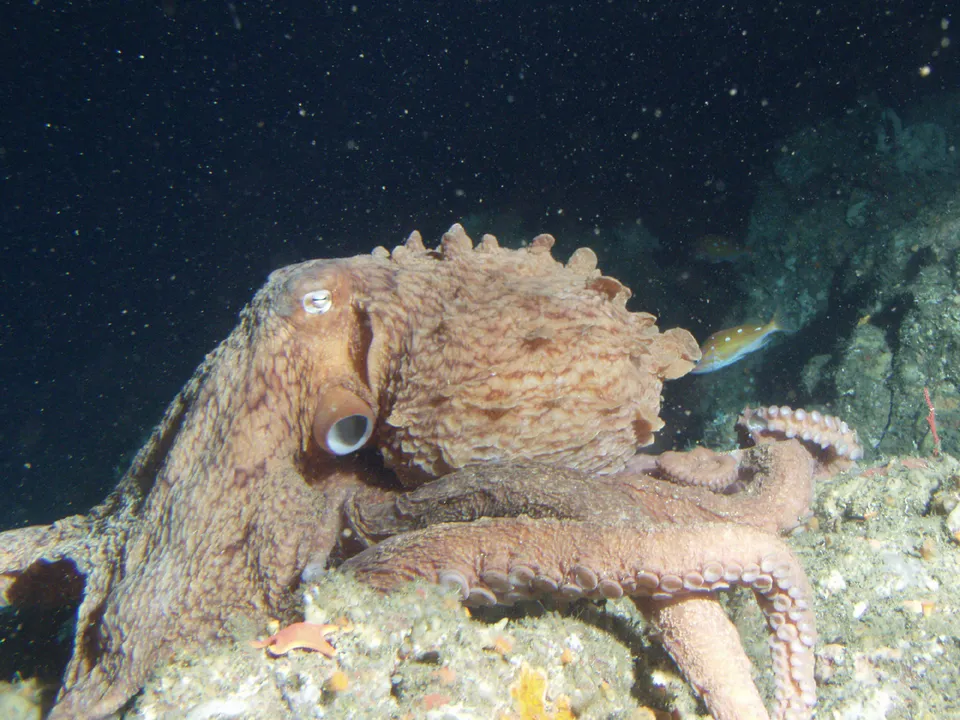
The giant Pacific octopus eats mostly crustaceans, mainly crabs, plus clams and other mollusks. Monterey Bay Aquarium also lists echinoderms such as sea stars, fish, fish eggs, abalone, scallops and, more rarely, seabirds and other octopuses as prey that it takes when the chance comes [3]. Animal Diversity Web, which studied the remains left near dens, sums up the adult diet as "clams, crabs, fish, and squid" [1].
It is also the largest octopus, with an arm span of at least 2 m (7 ft) [3], and our size comparison tool shows how that compares with a person. That variety fits an animal that lives in the ocean, from shallow water to depths of 1,500 m (4,900 ft) or more in cold water across the North Pacific [3]. A giant Pacific octopus is an opportunist: it eats what its habitat offers, and the shells left at the den are how scientists learn what that is.
What does a common octopus eat?
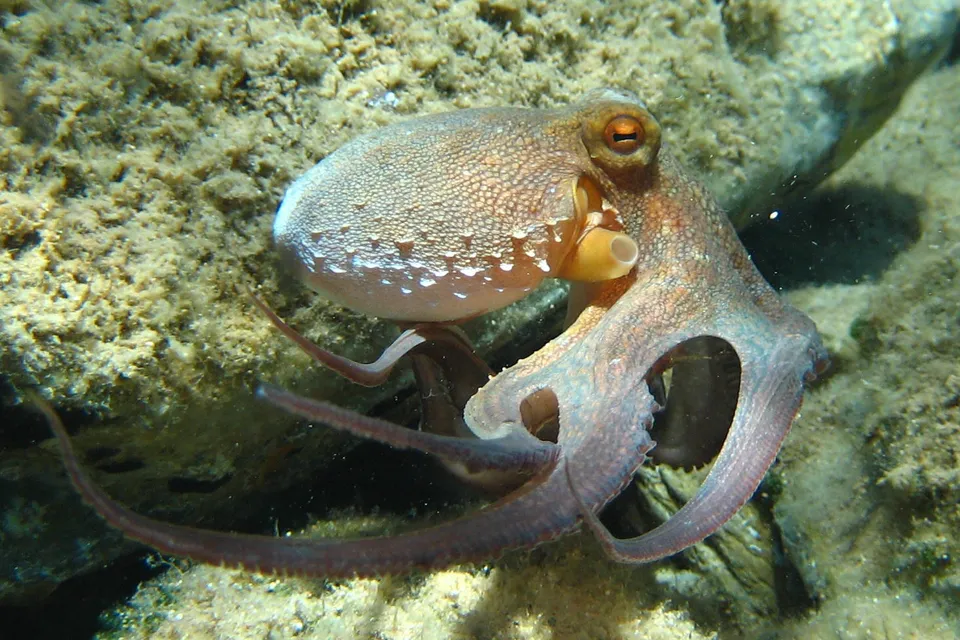
The common octopus (Octopus vulgaris) is described as an active predator that feeds primarily on gastropods and bivalves, which means snails and clams [2]. It lives in tropical, subtropical and temperate waters between the surface and about 100 to 150 m (330 to 490 ft) deep, mostly in coastal water and on the upper continental shelf (same source).
It is abundant in the Mediterranean, the eastern Atlantic and Japanese waters [2], so what an individual animal actually eats depends on what its local seabed offers. Our sources do not give a detailed prey list or a percentage breakdown for adult common octopuses, so we do not offer one. Any pie chart of "what octopuses eat" without a named source should be treated with caution, because diets differ between species, places and seasons.
What do baby octopuses eat?
Octopus life begins in open water, and the diet changes with each stage. Giant Pacific octopus larvae move to the surface and live as plankton for 1 to 3 months, then descend to the seafloor, where they grow rapidly [1]. Common octopus hatchlings also spend several weeks as plankton predators before they settle at about 0.2 grams [2]. For scale, a giant Pacific octopus hatchling is about a quarter-inch (6 mm) long and weighs just 22 milligrams [3].
What do these tiny hunters catch? A study that read the gut contents of wild common octopus paralarvae in the Ría de Vigo, off northwest Spain, found prey DNA in 96.9% of the animals. They mainly preyed on decapods, the group that includes crabs, even though decapods are a small share of the local plankton. Calanoid copepods were the second most frequent group, and fish were rare [4]. That is one region and one species, so it describes a well-studied example, not every octopus on Earth.
Researchers have also watched paralarvae in tanks. In a laboratory study, paralarvae were offered live wild zooplankton and spider crab and edible crab zoeae, and cameras recorded how they attacked prey and drilled through the outer skeleton [5]. Drilling, it seems, is a skill that starts early in life.
How does an octopus catch and open its food?
Adult giant Pacific octopuses are visual hunters. They stalk, chase and ambush, using camouflage and a jet of water to close the distance, and they can coordinate all eight arms to grip the prey [1]. Monterey Bay Aquarium describes the same pattern: surprise, camouflage, jet propulsion and the grip of the arms [3].
An octopus has no claws, so it relies on its arms, its beak and its radula to get at the soft meat inside a shell. Hard shells are the next problem, and there are three solutions.
- Pulling. The octopus uses its arm strength to pull a shell apart.
- Biting. It cracks the shell with its beak, which sits in the center of its arms.
- Drilling. Saliva softens the shell, and a rough tongue called a radula scrapes a small hole. The octopus then injects a toxin that paralyzes the prey and dissolves connective tissue.
Animal Diversity Web calls drilling with toxic saliva the most common method for the giant Pacific octopus [1], and Monterey Bay Aquarium describes the same three techniques [3].
The beak deserves a closer look. Monterey Bay Aquarium describes it as powerful and parrotlike, and the same page notes that the rough radula is what scrapes through a shell once the saliva has softened it [3]. Together they let a soft-bodied animal deal with some of the hardest packaging in the sea.
Afterwards, an octopus returns to its rocky den to eat and tosses the empty shells outside, building a pile called a midden. Scientists study middens to learn octopus diets, which is why so many dietary facts come from piles of shells.
How much do octopuses eat, and do they ever stop?
None of the sources we use gives a reliable daily or weekly amount for wild octopuses, so we do not give one. We would rather say "not known to us" than quote a figure from a source we cannot check.
What the sources do show is one clear exception to the hunting routine. Mothers stop eating while they guard their eggs. A female giant Pacific octopus guards her eggs for up to six months without eating and usually dies shortly after they hatch [3]. A female common octopus rarely leaves her egg mass and usually does not feed during spawning and brooding, which can last as long as 4 to 5 months at low temperatures [2].
What about octopuses in aquariums? The sources above do not describe adult aquarium menus, and we would not guess at one. Researchers have kept newly hatched paralarvae in tanks and recorded their feeding, as the study above did, but that tells us about research animals, not about a menu for adults. If you are curious how a particular aquarium feeds its octopus, ask the aquarium: they know their species and their animal.
Frequently Asked Questions
Do octopuses eat fish?
Some do, but fish are usually not the main course. Giant Pacific octopuses eat fish along with crabs, clams and squid [1]. In the wild paralarvae study, fish were rare in the gut contents [4].
Do octopuses eat other octopuses?
Occasionally, in some species. Monterey Bay Aquarium lists other octopuses among the animals a giant Pacific octopus may eat when the opportunity comes up [3].
How does an octopus eat through a shell?
By pulling it apart, biting it with its beak, or drilling a small hole with its radula and injecting a toxin through it. The giant Pacific octopus most commonly drills [1].
Do baby octopuses eat the same food as adults?
No. Hatchlings spend weeks to months in the plankton and catch tiny drifting animals, mostly decapods such as young crabs, and copepods, in the one wild population studied closely. Adults settle on the seafloor and hunt larger shellfish such as crabs and clams [1].
Our Take
We think the diet is the best window into how octopuses live. An animal that spends weeks as plankton, settles on the seafloor, and then ambushes crabs and opens clams is solving a different problem at every age. We also found it telling how much of this knowledge comes from shell piles outside dens and from DNA in tiny larvae, and how little comes from neat percentage tables. Where the sources give no number, such as how much an adult eats, we left it blank on purpose. For the animal itself, our octopus facts page covers the three hearts, the blue blood and the short lifespans. You can also see how other ocean animals feed in our guides to what orcas eat, what sharks eat and what dolphins eat.
Sources
- Enteroctopus dofleini (giant Pacific octopus). Animal Diversity Web.
- Octopus vulgaris (common octopus). Animal Diversity Web.
- Giant Pacific Octopus. Monterey Bay Aquarium.
- Diet Composition and Variability of Wild Octopus vulgaris and Alloteuthis media (Cephalopoda) Paralarvae: a Metagenomic Approach. Frontiers in Physiology, 2017.
- Prey Capture, Ingestion, and Digestion Dynamics of Octopus vulgaris Paralarvae Fed Live Zooplankton. PubMed Central.
Animal sizes and lifespans vary between populations, and between the wild and human care; we give ranges with sources. Spotted an error? Tell us.
Keep Exploring
Octopus Facts: Three Hearts, Blue Blood, and More
Octopus facts for curious readers and students: why they have three hearts and blue blood, how big they get, how long they live and how they hide.
What Do Sea Turtles Eat? Diet by Species
Sea turtles eat different foods by species: seagrass, jellyfish, sponges, crabs and more. See what each kind eats, from hatchling to adult, with NOAA sources.
What Do Orcas Eat? Diet by Population
Orcas eat different foods by population: salmon, seals and other marine mammals, or fish and sharks. See each diet explained with NOAA sources.
What Do Dolphins Eat? Fish, Squid and How They Hunt
Dolphins eat fish, squid and crustaceans. Learn how much a bottlenose eats a day, how dolphins find and catch food, and what calves eat, with sources.
Dolphin Facts: Intelligence, Pods, and Echolocation
Dolphin facts with sources: size, lifespan, echolocation, pods, calves and intelligence, plus where dolphins live and how U.S. law protects them.
What Do Sharks Eat? From Plankton to Seals
What sharks eat depends on species and age: filter feeders sift plankton, nurse sharks eat small fish, great whites hunt seals. Sourced diet and feeding facts.