Octopus Facts: Three Hearts, Blue Blood, and More
Quick Answer
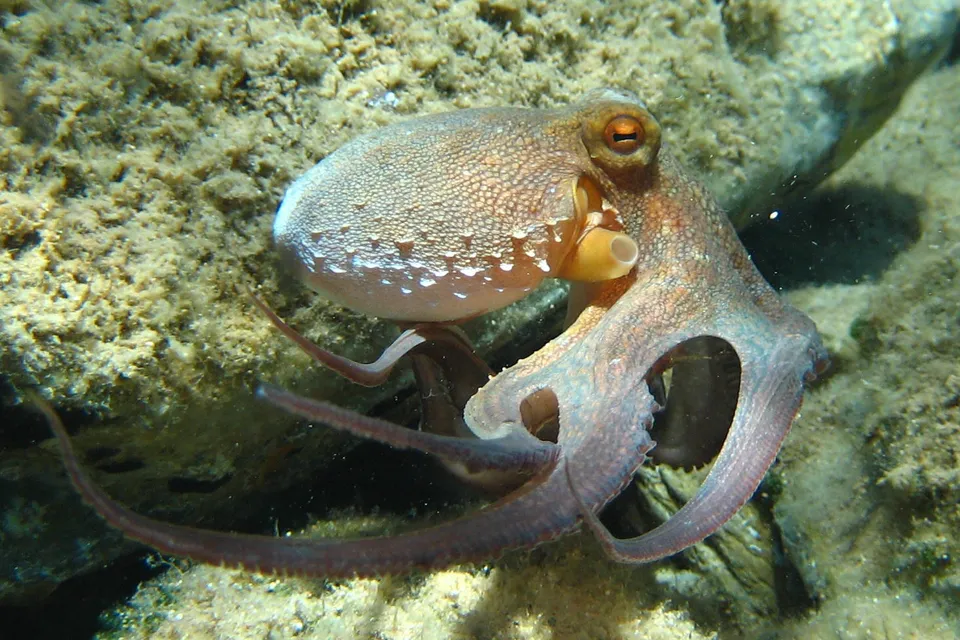
Octopuses are soft-bodied sea animals with eight arms, no shell and three hearts. Their blood looks blue because it carries oxygen with a copper-based protein called hemocyanin. Most octopuses live only a year or two, while the largest species, the giant Pacific octopus, lives about three to five years and can span 2 to 4 m (7 to 13 ft) from arm tip to arm tip.
On this page
Key Takeaways
- An octopus has three hearts: two push blood through the gills and one sends it around the body.
- Octopus blood is blue because its oxygen carrier contains copper, not iron.
- Sizes range from about 0.3 m (1 ft) for a common octopus to a giant Pacific octopus that can span more than 4 m (13 ft).
- Lifespans are short: 12 to 24 months for the common octopus, about 3 to 5 years for the giant Pacific octopus.
- Octopuses are hunters of shellfish and other small animals; the full menu is on our octopus diet page.
Octopus at a glance
Common octopus (Octopus vulgaris)
| Arm span | 30–90 cm (12–35 in)(animaldiversity.org) |
|---|---|
| Lifespan (wild) | 1–2 years(animaldiversity.org) |
| Diet | Active hunter that mostly eats snails and clams.(animaldiversity.org) |
| Habitat | Ocean: Tropical, subtropical and temperate waters worldwide, from the surface down to roughly 100–150 m.(animaldiversity.org) |
Sources give different figures for some of these numbers; we show the range they support.
Giant Pacific octopus (Enteroctopus dofleini)
| Arm span | 2–4 m (7–13 ft)(montereybayaquarium.org) |
|---|---|
| Weight | 23–91 kg (50–200 lb)(montereybayaquarium.org) |
| Lifespan (wild) | 3–5 years(montereybayaquarium.org) |
| Diet | Mostly shellfish, crabs and lobsters, along with other animals such as sea stars and sometimes fish or seabirds.(montereybayaquarium.org) |
| Habitat | Ocean: North Pacific, from Japan to Alaska and down to Baja California.(montereybayaquarium.org) |
Sources give different figures for some of these numbers; we show the range they support.
What exactly is an octopus?
An octopus is a mollusk, a relative of snails and clams, that gave up its shell. A common octopus has eight arms lined with suckers and no internal shell, which lets it squeeze into tight gaps [1]. The giant Pacific octopus carries about 2,240 suckers on its arms if it is a female, and roughly 100 fewer if it is a male [3].
Many people call these animals "octopi", and that plural is common in everyday speech. The plural "octopuses" is the standard English form, and the rare "octopodes" is the one that follows the Greek root. We use "octopuses" throughout WildFacts. If you enjoy this kind of detail, our fun facts collection has more short surprises from the animal world, and you can browse every profile on the animals page.
Octopuses belong to a group of animals called cephalopods. Different species vary a lot, so the numbers below name the species they describe. Nobody should expect one number to fit every octopus. The two we use most are the common octopus (Octopus vulgaris) and the giant Pacific octopus (Enteroctopus dofleini).
Why do octopuses have three hearts and blue blood?
An octopus does not circulate blood the way a person does. The octopus oxygen supply system is powered by three hearts: two branchial hearts that push blood through the gills, and a systemic heart that sends blood around the body. Researchers describe this as a closed circulatory system, which means the blood stays inside vessels [4].
The blue color comes from the oxygen carrier. Humans use hemoglobin, which contains iron and looks red. Octopuses use hemocyanin, a protein in which each oxygen-binding unit holds one oxygen molecule on a pair of copper atoms [4]. Octopus blood turns blue when hemocyanin is carrying oxygen, because of the copper ions in the molecule, and it becomes nearly clear when the oxygen is released [5].
A quick comparison helps keep the two systems straight:
| Feature | Octopus | Human |
|---|---|---|
| Hearts | 3 | 1 |
| Oxygen-carrying protein | Hemocyanin | Hemoglobin |
| Metal at the center | Copper | Iron |
| Color of oxygen-rich blood | Blue | Red |
How big do octopuses get?
It depends heavily on the species. The common octopus is a modest animal that reaches 0.3 to 0.9 m (1 to 3 ft) in length including its arms [1]. The giant Pacific octopus is the largest in the world. Its arm span is at least 2 m (7 ft) and often more than 4 m (13 ft), and the largest on record measured nearly 6 m (20 ft) across [3].
Weight tells the same story. Monterey Bay Aquarium reports that full-grown giant Pacific octopuses can weigh more than about 23 kg (50 lb), and that the heaviest recorded individual weighed about 91 kg (200 lb) [3]. Animal Diversity Web gives a much higher average of 60 kg (132 lb) and a maximum of 272 kg (600 lb) for the same species [2]. The two sources disagree, so treat giant Pacific octopus weights as a rough range, not a fixed number.
Measurements also differ by method. Animal Diversity Web lists an average dorsal mantle length of 50 to 60 cm (20 to 24 in) for the giant Pacific octopus, which is the body only, without the arms [2]. The arm span figures above include the arms, so a mantle length should never be compared directly with an arm span.
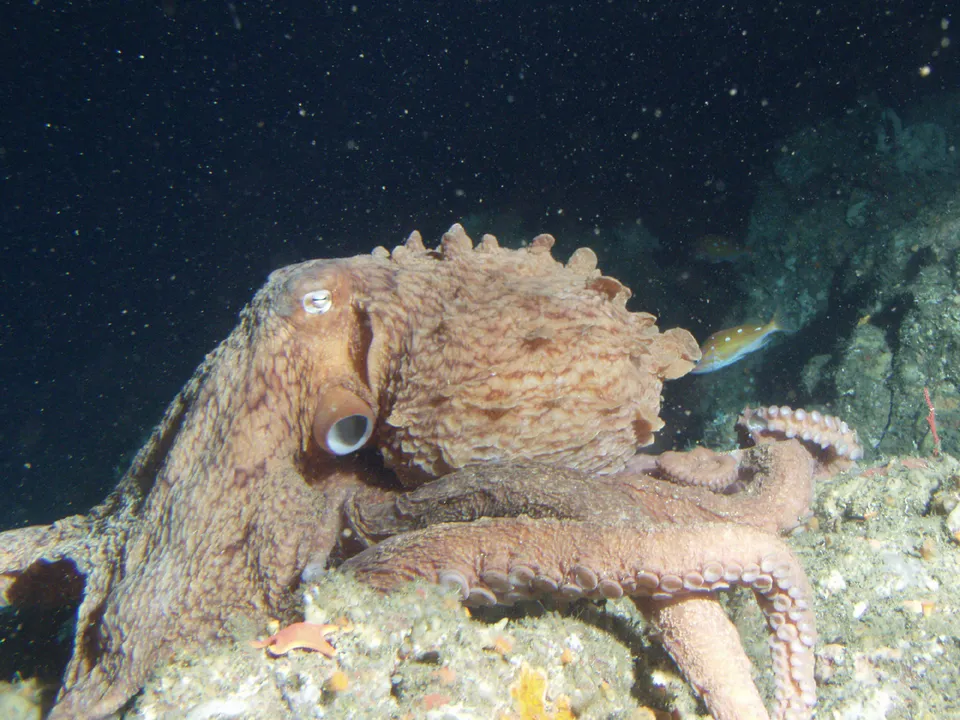
To put that in perspective, a giant Pacific octopus with its arms stretched out can be wider than a tall adult is high. Want to compare any animal with your own height? Try our size comparison tool.
How long do octopuses live?
Not long. The common octopus has a life span of 12 to 24 months [1]. The giant Pacific octopus lives about three to five years, which is long for an octopus, since octopuses in general usually live no more than a year or so [3]. Animal Diversity Web puts the same species at 4.5 to 5 years in the wild and in captivity [2]. Our sources do not split the common octopus figure into wild and aquarium lifespans, so we show it as a single reported range.
Octopus life starts small. A giant Pacific octopus hatchling is about a quarter-inch (6 mm) long and weighs 22 milligrams, roughly the size of a grain of rice, and it starts with about 14 suckers on each arm [3]. Common octopus hatchlings spend several weeks as part of the plankton, drifting in open water, before they settle to the bottom at about 0.2 grams [1].
The end of life is tied to reproduction. A female giant Pacific octopus lays 18,000 to 74,000 eggs, guards them for up to six months without eating, and usually dies shortly after they hatch [3]. A female common octopus lays far more, 100,000 to 500,000 eggs, and also stops feeding while she tends them. She dies shortly after the last young hatch, having lost about one third of her pre-spawning weight [1]. Before that, giant Pacific octopuses mate in deeper water, beyond 50 m (164 ft), and the female returns to shallower water to lay her eggs [3].
How smart are octopuses, and how do they hide?
Octopuses can learn. Animal Diversity Web notes that they can tell objects apart using visual, touch and chemical cues [1]. Giant Pacific octopuses in aquariums have learned to open jars, solve puzzles and interact with their caretakers [3]. Most of their lives are solitary, so these skills are not about group living.
Their camouflage is just as remarkable. An octopus can match nearly any surface by changing color, skin texture and posture [1]. The color change comes from millions of elastic color cells called chromatophores that are controlled by muscles and nerves. Experiments suggest the giant Pacific octopus is color-blind, which makes its matching even more surprising [3]. Color is also a signal. Monterey Bay Aquarium suggests that changing color may help an octopus communicate with a mate or warn off a rival, though the full meaning is still being studied [3]. If camouflage fails, an adult may release a cloud of ink that acts as a temporary visual barrier while it escapes (same source).
What do octopuses eat?
Octopuses are active hunters. The common octopus feeds mostly on snails and clams [1]. The giant Pacific octopus eats mainly crabs, clams and other mollusks, with other animals now and then [3]. They can pull shells apart, bite them open or drill through them. Baby octopuses start life drifting in the plankton and eat different food than adults. For the full menu, how they open shells and what changes with age, read what octopuses eat.
Where do octopuses live?
Octopuses live in oceans, and each species has its own range. The common octopus has a worldwide distribution in tropical, subtropical and temperate waters, from the surface down to a depth of 100 to 150 m (330 to 490 ft) [1]. The giant Pacific octopus prefers cold water of 16 °C (60 °F) or colder across the North Pacific, from Korea and Japan to Alaska, Canada, the United States and Mexico. It is found in shallow water and as deep as 1,500 m (4,900 ft) or more [3]. Common octopuses are absent from polar and subpolar regions [1]. Adult giant Pacific octopuses are commonly found in tide pools and as deep as 110 m (360 ft), though the species ranges much deeper [2]. Explore more animals of the open water in our ocean habitat guide, or see what an octopus actually puts on its plate in what octopuses eat.
Frequently Asked Questions
Do octopuses really have eight legs?
They have eight arms, not legs. Each arm is lined with suckers, and octopuses can use all eight arms together when they attack prey, according to Animal Diversity Web [2].
Do octopuses have bones?
No. A common octopus has no internal shell and its body is soft [1]. Its main hard part is a powerful, parrot-like beak, which the giant Pacific octopus uses to bite into food [3].
Which octopus is the biggest?
The giant Pacific octopus. Its arm span is often more than 4 m (13 ft), and its body can reach about 60 cm (2 ft) long [3].
Do octopuses live in groups?
Not usually. A giant Pacific octopus lives alone for most of its life, and only seeks a mate near the end of it [3].
Our Take
We think the most useful octopus fact is also the least glamorous one: these animals live fast and briefly. Three hearts and blue blood get the headlines, but the short lifespan explains a lot, from rapid growth to the way mothers give everything to their eggs. We also like that the sources disagree in places, such as the weight of the giant Pacific octopus, because it reminds readers that ranges are more honest than single numbers. If you only remember two things from this page, make them the copper-based blood and the one-to-five-year lifespans. For other ocean animals worth a look, try our shark facts and dolphin facts.
Sources
- Octopus vulgaris (common octopus). Animal Diversity Web.
- Enteroctopus dofleini (giant Pacific octopus). Animal Diversity Web.
- Giant Pacific Octopus. Monterey Bay Aquarium.
- Positive selection in octopus haemocyanin indicates functional links to temperature adaptation. BMC Evolutionary Biology, 2015.
- Acute-Stress Biomarkers in Three Octopodidae Species After Bottom Trawling. Frontiers in Physiology, 2019.
Animal sizes and lifespans vary between populations, and between the wild and human care; we give ranges with sources. Spotted an error? Tell us.
Keep Exploring
What Do Octopuses Eat? Diet, Hunting and Baby Food
What do octopuses eat? See the diet of the giant Pacific and common octopus, what baby octopuses eat, and how they open shells, with sources cited.
What Do Sea Turtles Eat? Diet by Species
Sea turtles eat different foods by species: seagrass, jellyfish, sponges, crabs and more. See what each kind eats, from hatchling to adult, with NOAA sources.
What Do Orcas Eat? Diet by Population
Orcas eat different foods by population: salmon, seals and other marine mammals, or fish and sharks. See each diet explained with NOAA sources.
What Do Dolphins Eat? Fish, Squid and How They Hunt
Dolphins eat fish, squid and crustaceans. Learn how much a bottlenose eats a day, how dolphins find and catch food, and what calves eat, with sources.
Dolphin Facts: Intelligence, Pods, and Echolocation
Dolphin facts with sources: size, lifespan, echolocation, pods, calves and intelligence, plus where dolphins live and how U.S. law protects them.
What Do Sharks Eat? From Plankton to Seals
What sharks eat depends on species and age: filter feeders sift plankton, nurse sharks eat small fish, great whites hunt seals. Sourced diet and feeding facts.