What Do Sea Turtles Eat? Diet by Species
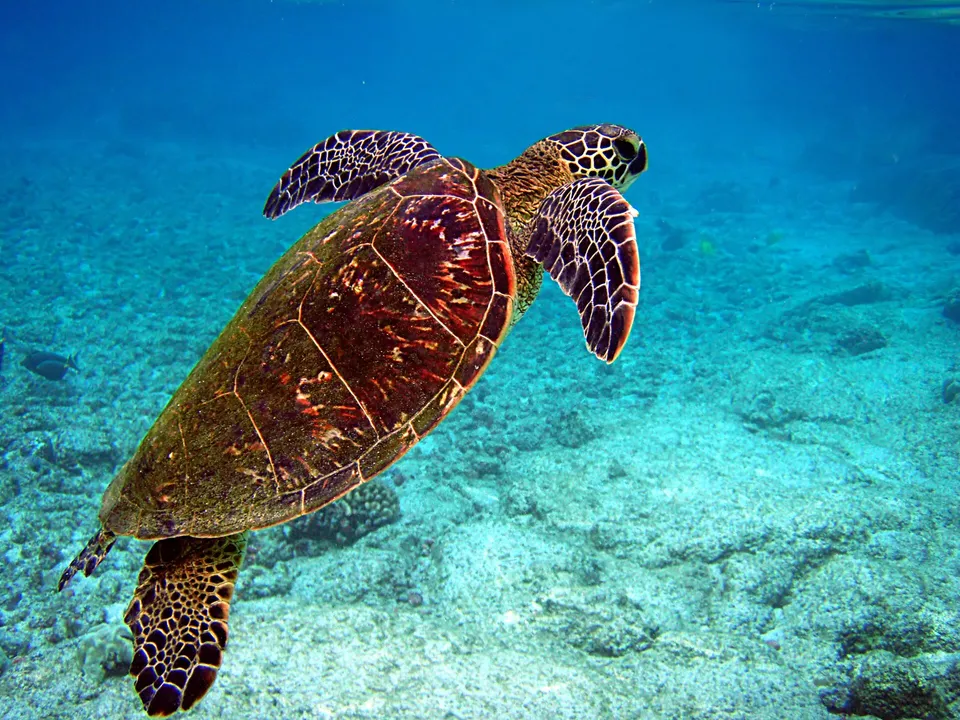
Quick Answer
Sea turtles eat different foods depending on the species. Green turtles are the only herbivorous sea turtle, grazing on seagrass and algae as adults. Leatherbacks eat soft prey such as jellyfish and salps, loggerheads crush hard-shelled animals like whelks and crabs, hawksbills favor reef sponges, and Kemp's ridleys prefer crabs. Young turtles often feed on both plants and animals in the open ocean.
On this page
- Do all sea turtles eat the same thing?
- What do green sea turtles eat?
- What do leatherback sea turtles eat?
- What do loggerhead, hawksbill and Kemp's ridley turtles eat?
- What do olive ridley and flatback turtles eat?
- Do sea turtles eat plastic bags?
- How do sea turtle diets matter for protection?
- Frequently Asked Questions
- Our Take
- Sources
Key Takeaways
- There is no single sea turtle diet: the food depends on the species, and often on the turtle's age.
- Green turtles are the only herbivorous sea turtle, but their diet is wider when they are young.
- Leatherbacks specialize in jellyfish and salps, loggerheads in hard-shelled animals, hawksbills in sponges and Kemp's ridleys in crabs.
- NOAA warns that sea turtles can mistake marine debris, including plastic bags, for food, and calls this a threat to all species.
Do all sea turtles eat the same thing?
No. Across the whole group, sea turtles eat things like sponges, jellyfish, snails, crabs, algae, plants and fish [8], but any one species uses only part of that menu. The shape of a turtle's head and beak is a good clue to what it eats. A broad head with strong jaws suits crushing shells, a pointed beak suits reaching into reef holes, and a jaw with sharp edges suits soft prey.
Diet also changes with age. Many young turtles spend their first years drifting in the open ocean before they move to coastal waters, and the food they find in each place is different. The article below follows the species one by one. It covers green, leatherback, loggerhead, hawksbill, Kemp's ridley, olive ridley and flatback turtles, and it says plainly when the sources we can use give only a short description.
What do green sea turtles eat?
Green turtles are "the only herbivorous species of sea turtle," according to NOAA Fisheries. Their diet is mostly algae and seagrasses, but they may also eat sponges and other invertebrates, and discarded fish and bait when those are available [1]. NOAA adds that the East Pacific population eats more animal prey than other green turtle populations.
A green turtle does not start out as a grazer. After hatching, young turtles live in the open ocean for several years, where "pelagic juveniles forage on plant and animal life found in oceanic drift communities," such as floating Sargassum. NOAA does not say exactly what hatchlings eat. Later the juveniles move to shallow coastal feeding grounds, and adults feed in coastal foraging areas, then migrate every 2 to 5 years to nesting beaches.
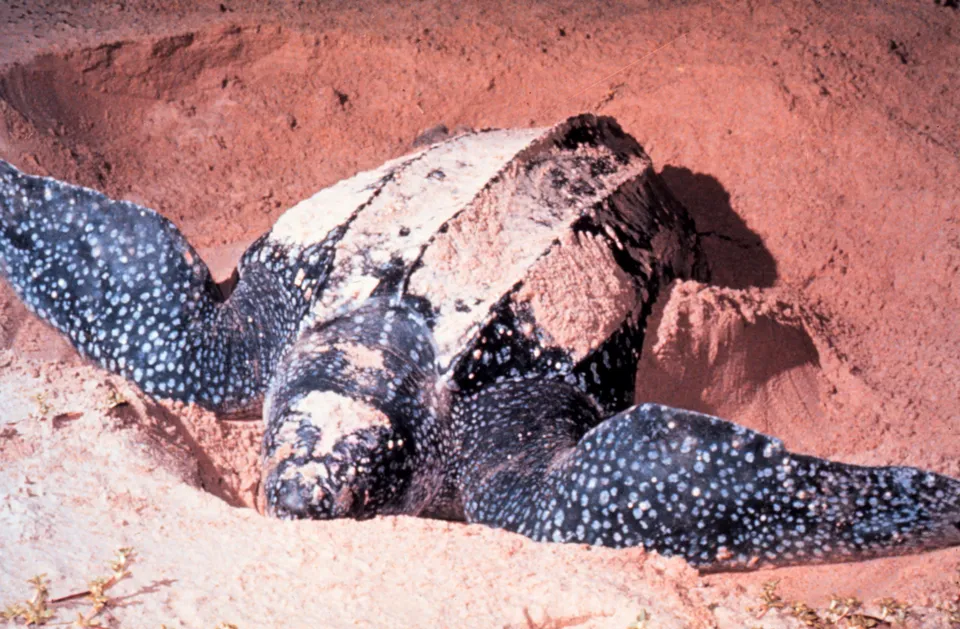
What do leatherback sea turtles eat?
Leatherbacks eat soft-bodied open ocean prey such as jellyfish and salps [2]. Their jaws have sharp edges and pointed cusps instead of a crushing beak, which suits soft food. Backward-pointing spines in the mouth and throat help them hold on to slippery prey.
Adult leatherbacks are about 1.5 to 1.8 m (5 to 6 ft) long [2]. To find jellyfish it dives deeper than any other turtle. NOAA reports dives to about 1,200 m (4,000 ft) that can last up to 85 minutes. Jellyfish are the turtle's food, so if you want to know more about them, see the jellyfish hub.
What do loggerhead, hawksbill and Kemp's ridley turtles eat?
These three species all eat animals, but each has a different favorite.
Loggerheads are carnivores that only occasionally eat plant material. Coastal juveniles and adults eat mostly bottom-dwelling invertebrates, including mollusks, crustaceans and horseshoe crabs, and NOAA names whelks and conch as typical hard-shelled prey. A large head supports powerful jaw muscles built to crush these animals [3]. Hatchlings and young juveniles in the open ocean eat a wide variety of floating items.
Hawksbills are omnivores whose main food is sponges that live on coral reefs. NOAA calls them "the only species of sea turtle that can survive on a diet consisting mainly of sponges." They also eat algae, corals, mollusks, tunicates, crustaceans, sea urchins, small fish and jellyfish. Their pointed, hawk-like beak lets them reach into small holes and crevices in reefs. In Hawaii, where sponges are less available, NOAA describes them as opportunistic feeders [4].
Kemp's ridleys change food as they grow. Young turtles that live in the open ocean near floating Sargassum feed on small animals and plants. After they move to shallow coastal areas, crabs are their preferred food, and adults live mainly in nearshore habitats with muddy or sandy bottoms [5]. If you are curious about the prey, browse the crab hub.
What do olive ridley and flatback turtles eat?
Olive ridleys are omnivorous and feed on a wide variety of foods, including algae, crustaceans, tunicates and mollusks. NOAA says they can dive to depths of up to about 150 m (500 ft) to forage for bottom-dwelling invertebrates [6].
Flatback turtles are native to northern Australia and rarely travel far from home. Animal Diversity Web says they seek out sea cucumbers, mollusks, jellyfish, prawns, bryozoans and other invertebrates in shallow waters, and that they are carnivorous and rarely, if at all, eat vegetation [7]. That page was last updated in 2003, so treat the details as a general guide. We could not use a NOAA species page for the flatback, which is why we rely on this older reference.
Do sea turtles eat plastic bags?
Sometimes, by mistake. NOAA says green turtles may ingest marine debris such as fishing line, balloons and plastic bags, and that they eat it because they can mistake it for food [1]. The leatherback page lists similar items [2], and the loggerhead page says that floating trash and debris can be mistaken for food and that small plastic fragments are often eaten [3]. NOAA calls the ingestion of debris another threat to all species of sea turtles.
The sources we can use do not explain exactly why a turtle takes a bag for food, so we do not claim a specific cause. The practical lesson is simple: what ends up in the ocean can end up in a turtle's diet. Picking up trash, using less single-use plastic and never releasing balloons are small steps that keep it out of the water. For wider context, see our pages on ocean habitats and conservation.
How do sea turtle diets matter for protection?
Because each species leans on a different food, each depends on a different part of the ocean. Seagrass beds and reefs, coastal bottoms and open-water jellyfish are all separate habitats. NOAA lists the leatherback as endangered under the U.S. Endangered Species Act [2]. It lists green turtles by population segment instead of as one group, with 3 endangered and 8 threatened [1].
Sea turtles are wild animals, and people should not feed or approach them. For a broader overview of the group, head to the sea turtle hub, or browse all animals.
Frequently Asked Questions
Do sea turtles eat jellyfish?
Yes, some do. Leatherbacks eat jellyfish and salps as their main food. Hawksbills, flatbacks and some other species also eat jellyfish as part of a wider diet, according to NOAA and Animal Diversity Web.
Which sea turtle is a vegetarian?
The green sea turtle. NOAA calls it the only herbivorous sea turtle, eating mostly algae and seagrasses as an adult. Young green turtles also eat animal food in the open ocean.
What do baby sea turtles eat?
It depends on the species. NOAA says young green turtles that live offshore forage on plant and animal life in oceanic drift communities, young loggerheads eat a wide variety of floating items, and young Kemp's ridleys feed on small animals and plants near Sargassum. NOAA does not list a specific hatchling menu.
Do sea turtles eat crabs?
Yes. Kemp's ridleys prefer crabs, and loggerheads eat crustaceans, including crabs, along with mollusks and horseshoe crabs, according to NOAA.
Our Take
We think the best way to understand sea turtle food is to stop thinking of it as one diet. A green turtle grazing on seagrass and a leatherback chasing jellyfish are both sea turtles, but their mouths, dives and habitats have little in common. Based on the NOAA pages we cite, the common thread is vulnerability: each species relies on a particular kind of food, and every species can mistake debris for a meal. We also want to be honest about gaps. The sources we can use give only brief descriptions for some species, hatchling menus are not specified, and the flatback information is older, so we state what is known and stop there.
Sources
- Green Turtle. NOAA Fisheries, 2025.
- Leatherback Turtle. NOAA Fisheries, 2025.
- Loggerhead Turtle. NOAA Fisheries, 2025.
- Hawksbill Turtle. NOAA Fisheries, 2025.
- Kemp's Ridley Turtle. NOAA Fisheries, 2025.
- Olive Ridley Turtle. NOAA Fisheries, 2025.
- Natator depressus (flatback turtle). Animal Diversity Web, 2003.
- Cheloniidae (sea turtles). Animal Diversity Web.
Animal sizes and lifespans vary between populations, and between the wild and human care; we give ranges with sources. Spotted an error? Tell us.
Keep Exploring
What Do Octopuses Eat? Diet, Hunting and Baby Food
What do octopuses eat? See the diet of the giant Pacific and common octopus, what baby octopuses eat, and how they open shells, with sources cited.
Octopus Facts: Three Hearts, Blue Blood, and More
Octopus facts for curious readers and students: why they have three hearts and blue blood, how big they get, how long they live and how they hide.
What Do Orcas Eat? Diet by Population
Orcas eat different foods by population: salmon, seals and other marine mammals, or fish and sharks. See each diet explained with NOAA sources.
What Do Dolphins Eat? Fish, Squid and How They Hunt
Dolphins eat fish, squid and crustaceans. Learn how much a bottlenose eats a day, how dolphins find and catch food, and what calves eat, with sources.
Dolphin Facts: Intelligence, Pods, and Echolocation
Dolphin facts with sources: size, lifespan, echolocation, pods, calves and intelligence, plus where dolphins live and how U.S. law protects them.
What Do Sharks Eat? From Plankton to Seals
What sharks eat depends on species and age: filter feeders sift plankton, nurse sharks eat small fish, great whites hunt seals. Sourced diet and feeding facts.